Two herbs. Thousands of years of proof. Every Vimal Vihar product begins with one extraordinary ingredient — sourced purely, tested carefully, and formulated with deep respect for classical Ayurvedic tradition.
At Vimal Vihar, we believe that nature holds a profound intelligence — an intelligence encoded in the chemistry, the structure, and the energetics of plants. Ayurveda has been reading and working with that intelligence for over 5,000 years.
We do not choose ingredients for trends or marketing. We choose ingredients because thousands of years of classical knowledge and modern scientific research both confirm their power, their safety, and their alignment with the human body's natural intelligence.
"The physician who knows the properties of herbs is the master of life and death." — Charaka Samhita
Currently we work with two of Ayurveda's most revered herbs. In time, the library will grow — but only when we are certain that every new addition meets the same standard of purity, tradition, and proven efficacy.
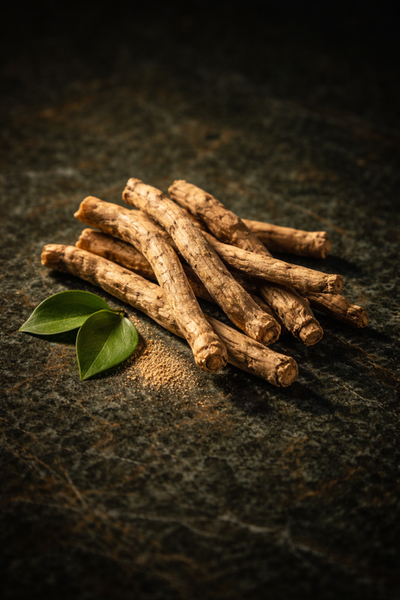
Ashwagandha is perhaps the most celebrated herb in the entire Ayurvedic tradition. For over 3,000 years it has been prescribed as the ultimate Rasayana — a herb that builds ojas, the essential life force, restoring vitality and resilience at the deepest level of the human system.
In Sanskrit, Ashwa means horse and Gandha means smell — a reference both to the earthy aroma of its root and to its legendary capacity to impart the strength, stamina, and vitality of a horse.
In classical Ayurvedic texts including the Charaka Samhita and the Ashtanga Hridayam, Ashwagandha is described as one of the most important Rasayana herbs — prescribed for strengthening the body's fundamental tissues (dhatus), calming the nervous system (Vata dosha), and building long-term vitality.
It was traditionally given to elderly people to restore youth-like vigour, to children for healthy development, and to people recovering from illness or exhaustion. The Charaka Samhita specifically names it as a herb that promotes longevity, memory, and freedom from disease.
Classical preparations included Ashwagandha Churna (powder), Ashwagandharishta (herbal wine), and Ashwagandha Ghrita (in clarified butter) — each method designed to carry the herb's active constituents deep into the body's tissues.
Contemporary research has confirmed what Ayurvedic physicians observed thousands of years ago. Ashwagandha's primary active compounds — withanolides — have been extensively studied for their adaptogenic, anti-stress, neuroprotective, and anti-inflammatory properties.
Clinical trials conducted at AIIMS, IIT, and internationally have demonstrated measurable reductions in cortisol levels, improvements in sleep quality, enhanced athletic performance, and significant reductions in perceived stress and anxiety among participants taking standardised Ashwagandha root extract.
We use only the purest Ashwagandha root essence — the Sattvam, or pure essence — extracted from the root, which contains the highest concentration of the herb's active withanolides. No stem, no leaf, no filler — only the root, only the essence.
The classical texts are clear that the root is the most potent part of the plant for Rasayana purposes. We honour that knowledge while ensuring our extraction process preserves the full spectrum of the herb's natural intelligence.
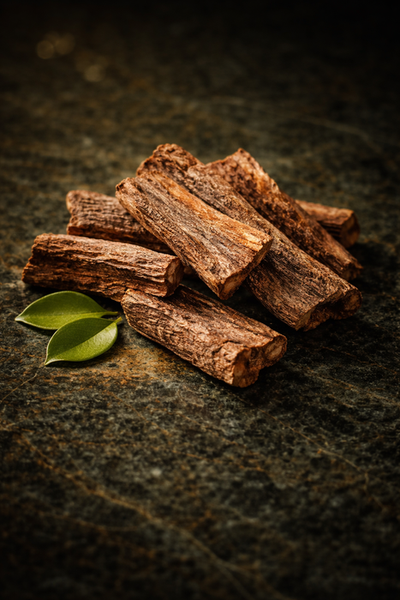
Named after Arjuna — the legendary warrior of the Mahabharata, celebrated for his courage, his focus, and the strength of his heart — this sacred tree has stood at the centre of Ayurvedic cardiology for thousands of years.
The bark of the Arjuna tree contains a unique combination of glycosides, flavonoids, and tannins that work synergistically to strengthen the cardiac muscle, regulate heart rhythm, and support the entire circulatory system.
In classical Ayurvedic texts, Arjuna bark is specifically classified as a Hridaya herb — a herb for the heart. The Charaka Samhita and Sushruta Samhita both describe it as the premier remedy for heart conditions, circulatory weakness, and disorders of the blood.
Vagbhata, the physician-author of the Ashtanga Hridayam, wrote extensively about Arjuna's capacity to strengthen the heart muscle directly — an observation that modern cardiology has since validated through clinical research. It was traditionally prepared as Arjunaksheerapaka — simmered in milk to draw out its fat-soluble cardiac glycosides.
Beyond the heart, Arjuna was also used to heal wounds, support liver function, and strengthen bones — reflecting the holistic view of health that runs through classical Ayurvedic medicine.
Research from institutions including AIIMS New Delhi and international cardiovascular studies have confirmed Arjuna bark's cardioprotective properties. The active glycosides — arjunic acid, arjunolic acid, arjunone, and arjunetin — have demonstrated measurable effects on cardiac output, blood pressure, and myocardial function.
Clinical studies have shown Arjuna bark extract to improve left ventricular function, reduce LDL cholesterol, support healthy blood pressure levels, and provide antioxidant protection to the cardiac muscle itself. It is now used in integrative cardiology in India as a complementary support for heart health.
We use only the purest Arjuna bark essence — the Sattvam extracted from the outer bark, which contains the highest concentration of the herb's active cardiac glycosides and flavonoids. No wood, no filler, no dilution — only the bark, only the essence.
The classical texts are explicit: it is the bark that carries the heart-strengthening intelligence of this tree. We honour that with our extraction process, which is designed to preserve the full spectrum of Arjuna's natural cardiac intelligence.
Every herb that carries the Vimal Vihar name has passed through the same rigorous process — from ethical sourcing to classical formulation to modern quality testing. There are no shortcuts on this path.